
Rajat Kapoor’s upcoming release RK/Rkay, a meta-comedy, is releasing on the big screens this Friday. So, how fitting is it to focus on the characteristics of a meta film in my comeback write-up? And to do so, I’m picking up the Tamil flick Uttama Villain, made at a time when the trend of meta cinema was just on the verge of explosion.
Before we get there, let’s understand- What is a meta film? In layman’s terms, it’s a film about the “making of a film”. However, there can’t be a precise definition for it. Yes! The genre keeps evolving with an array of new cinematic tropes, with which the filmmakers are keen to experiment. Albeit with a dash of gimmicks and cliches! But on the contrary, the Kamal Haasan-led ‘Uttama Villain’ is devoid of such corny tropes. In a way, it redefines the elements of a meta film through its multi-layered narrative.
To give you a detailed insight into the same, let’s break down the analysis of the film into three noteworthy pointers.
Expectation Effect
When Kamal Haasan writes, he really writes! And that’s what the script of Uttama Villain resembles, a supreme on-page substance. In a nutshell, Uttama Villain revolves around an ageing superstar, who after a personal tragedy, changes his course of life by confronting his past mistakes and setting up his legacy in the future. An ageing superstar? The characteristic of the protagonist is intriguing in itself as in a way it might seem synonymous with Kamal’s real life. This is the first stage where the expectations of the viewers are being experimented with, precisely, the stage is set!
Our protagonist, the superstar, wants to make a film with his mentor- director Margadarsi. After several meetings, the duo team up for this project titled ‘Uttama Villain’, which documents the story of a folk artist trying to oust a devious king.
And this making of fiction parallels our protagonist’s story in different directions, but reaches the same destination! Both the stories unfold simultaneously, portraying the expectation effect of our protagonist and the viewers. In simple words- The expectation effect is a phenomenon wherein perception changes based on personal expectations or the expectations of others.
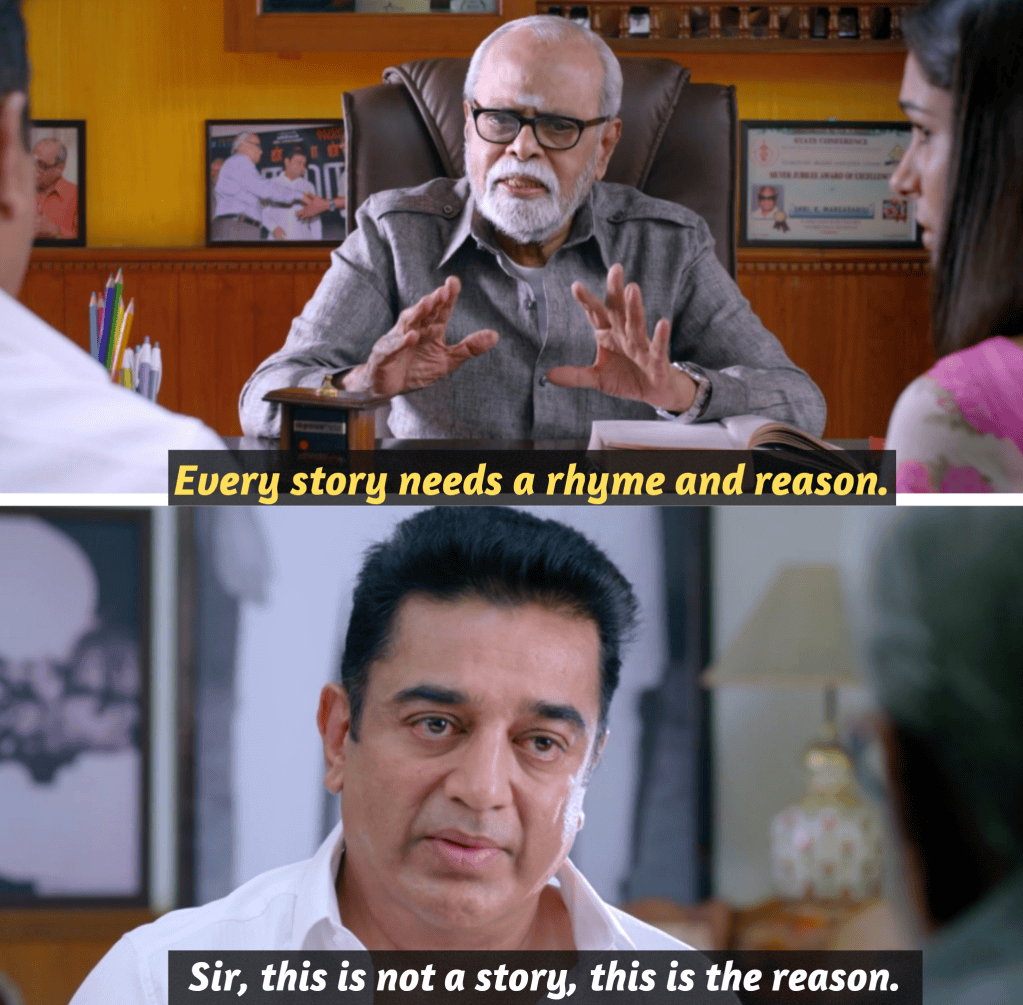
Subtly Breaking The Fourth Wall
Uttama Villain does not break the fourth wall in literal terms of cinema, however, the parallel narrative stands no less than an invisible fourth wall. While doing so, the movie offers notable perspectives on the reality of formula films and cinema as an illusion of reality. And these two factors become the initial and concluding point of our protagonist’s journey.
The parallel folk-like tale here i.e ‘the making of the film’ becomes escapism to the viewers, from the emotionally-driven story of our hero. The viewers never seep into it, nonetheless, the inventive style of the dual narrative becomes the highlight of the film. And it’s no less than a treat for the movie buffs.
As Simple As It Gets
Unlike other meta films, Uttama Villain is not laden with complex storylines, suspenseful tropes, etc. It stays true to the roots of the story and quite conveniently essays a simple-yet-powerful point about the conscience of an artist’s life. For me, it’s no less than Pyaasa or Rockstar. And all credits to the simple, linear storyline, adopted by director Ramesh Aravind.
Precisely, these three factors make Uttama Villain stand out in the genre of meta films. Uttama Villain is streaming on ZEE5.


Leave a comment